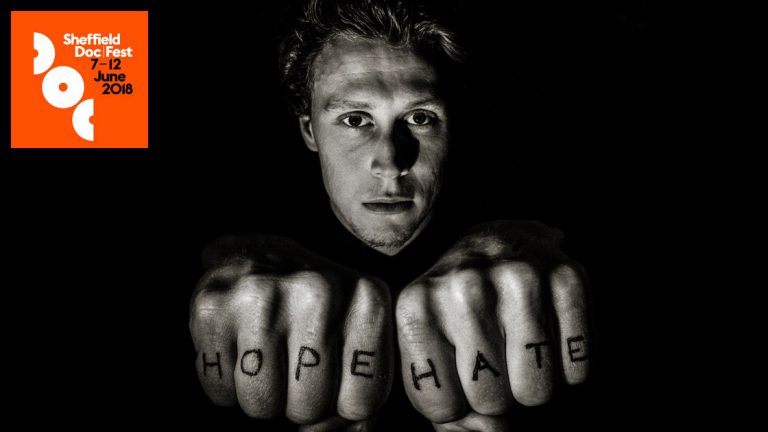
DOUBLETHINK was made in the long, sour aftermath of the 2016 referendum, when a whole country had been reduced to two positions. Orwell coined doublethink in Nineteen Eighty-Four to describe a mind that can hold two contradictory beliefs at once and believe both, and in the same novel invented the Two Minutes Hate, where a population gathers at a screen each day to be made furious together. Neither felt like fiction any more.
Forsyth & Pollard worked with Stuart Evers to develop two parallel monologues, one called HOPE and the other HATE. These were informed by input from mental health researchers including Prof. Emily Holmes, Dr. Robb Rutledge and Dr. Susanne Schweizer. Then they invited the actor George MacKay to embody the characters and perform them. Each monologue was spoken directly to camera and filmed in a single take.
Presented as rear projections on custom-built screens with 5.1 surround sound. During DocFest we installed two shipping containers on Tudor Square, marked one HOPE and one HATE, and asked people to commit to a door, where their hand was ink-stamped, knowing they could not come back for the other.
We’re drawn to this idea that contrary states aren’t a binary choice. Doctrines and ideologies that force people to one side of the argument or the other invariably filter out all the shades of grey in between. So that’s really what this piece is about – it’s asking us to embrace the grey area.
Iain & Jane talking to Now Then Magazine


Photography: Paul Heartfield


Photography: Paul Heartfield
We often come back to the famous Milton quote from Paradise Lost, “The mind is its own place, and in itself can make a heaven of hell, a hell of heaven.” We’re intrigued by how much they rely on each other. Right and wrong, angels and demons. The poet William Blake wrote, “Without contraries is no progression. Attraction and repulsion, reason and energy, love and hate are necessary to human existence."
Iain & Jane talking to Now Then Magazine